

Search that question online, and you’ll get two answers, both delivered with confidence.
One camp insists AI ruined SEO.
The other insists it’s the only tool worth using these days.
And they both miss the point.
AI already has a place in SEO, whether anyone likes it or not. The real question isn’t whether AI can do your SEO. It’s who’s driving it: someone with a decade of proven results, or someone who typed one prompt into a chatbot last week and decided that made them an expert.
A World Flooded With Self-Appointed SEO “Experts”

Anyone can open an AI tool and generate a keyword list in minutes, a content calendar in an afternoon, or a full page of website copy before lunch. That ease is the exact problem.
It’s created a wave of self-declared SEO experts who have never audited a website, diagnosed and remedied technical issues, or had to explain a ranking drop to an actual client.
Google noticed this too. The February 2026 update specifically targeted low-value, mass-produced content, the kind that rehashes what’s already ranking without adding anything new for the user/reader.
That’s the trap self-appointed experts fall into. They use AI to replace expertise rather than sharpen it.
The Real Divide Isn’t Human vs. AI
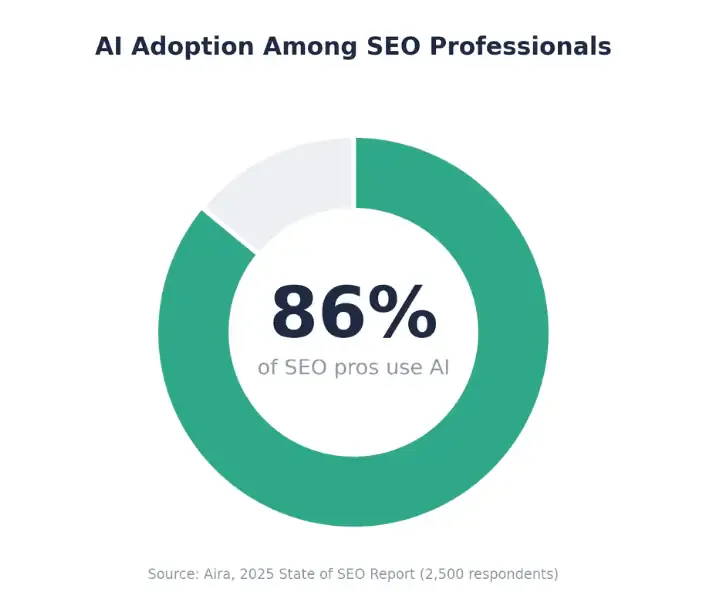
So, what do most people get wrong? The real divide in SEO was never AI users versus non-AI users. Nearly every serious SEO professional uses AI now, with an estimated 86% folding it into their strategy, a number that keeps climbing year over year.
The real divide is something else altogether. It’s the gap between people who use AI as a tool built on years of pattern recognition and those who use AI as a substitute for strategy and SEO knowledge altogether.
Here’s what that looks like in practice:
Self-Proclaimed “Expert” vs. Seasoned SEO Professional
| Factor | Self-Proclaimed “SEO Expert” | Seasoned SEO Professional |
|---|---|---|
| How AI output is used | Copied and published largely as is | Treated as a first draft, checked against strategy and data |
| Editing before publishing | Rarely reviewed | 86% of marketers review and edit AI-generated content before it goes live |
| Tools in the workflow | Usually a general chatbot | Enterprise teams run an average of 4.2 different AI tools |
| What shapes the prompts | Guesswork | Years of ranking data, client history, competitor research and industry knowledge |
| Typical outcome | Content flagged as thin or repetitive, and is penalized by Google | 83% report improved performance after incorporating AI |
What the Data Shows
The numbers back this up, though they take a second to unpack.
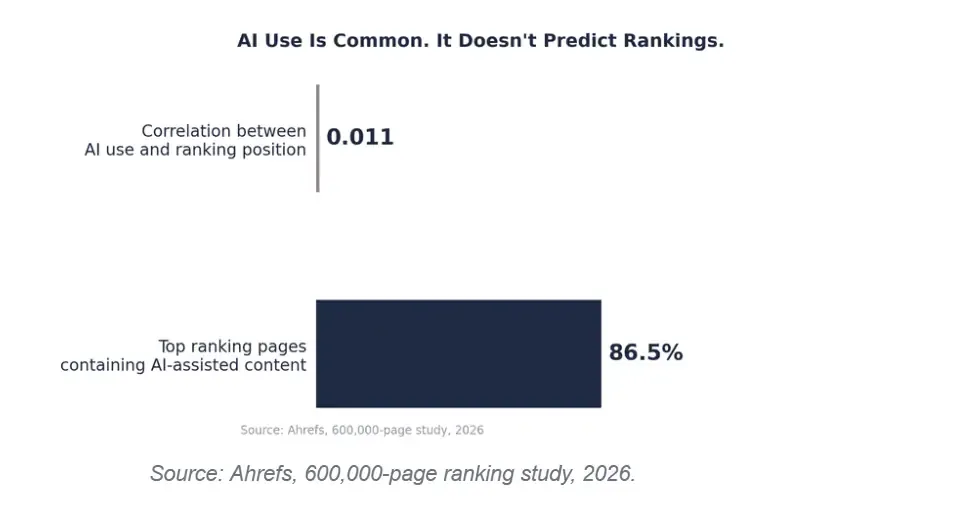
Almost every page at the top of Google’s results now contains AI-assisted content: 86.5% of them, according to Ahrefs’ study of 600,000 pages. On its own, that number makes it seem like AI got those pages to the top.
It isn’t. When Ahrefs checked how closely AI use actually aligns with ranking position, the correlation was 0.011. That’s close enough to zero to call it no relationship at all. A heavily AI-assisted page is no more likely to rank well than one that isn’t.
Put the two numbers together, and the “takeaway” is simple. AI use is now the norm, not the edge. Almost everyone has it, so having it isn’t what separates the pages that rank from the ones that don’t. Something else is doing that work.
That “something else” is expertise, which is exactly what shows up when real strategy sits behind the AI use:
| Proof Point | What It Means |
|---|---|
| 86.5% of top-ranking pages contain AI-assisted content, with a 0.011 correlation to ranking position (Ahrefs) | AI involvement alone predicts nothing. Quality and expertise do the actual work. |
| AI tools can lift rankings by up to 49.2% when used strategically (SEMrush) | Strategy is the multiplier, not the software. |
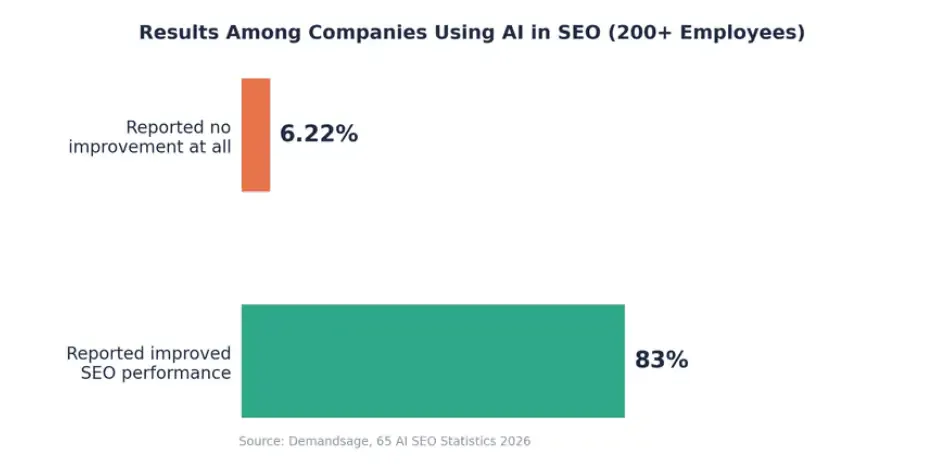
| Only 6.22% of surveyed SEO professionals saw no improvement from AI at all | The people who know how to use it are seeing tangible results. |
| Google’s 2026 updates continue to target mass-produced content lacking human input | The algorithm punishes the shortcut use of AI, not AI itself. |
How Many SEO Experts Are Posers?
Long before anyone was prompting a chatbot for a keyword list, people were already selling fake credentials, guaranteed rankings, and links from “high DA” sites that do nothing for rankings at all. Laymen posing as SEO experts, in essence.
The tells are usually the same. Confident language, no real audit of your site, and a pitch that moves fast because it can’t survive close questioning. “Snake oil,” in a nutshell.
Search Engine Journal rounded up ten of these “cons” still making the rounds to this day. Which brings us back to the precise point. Spotting a fake is only half the job. Knowing what real expertise looks like matters just as much, and that’s where AI, used properly, earns its keep!
Where Human Judgment Still Matters

Exemplary SEO teams aren’t precious about AI. They use it the way a skilled tradesperson uses a power tool rather than a hand tool: to work faster, not to cut corners.
What they don’t do is let AI replace judgment, the kind built from years of watching what actually moves rankings. That’s the difference an experienced SEO team brings to the table over someone running prompts alone.
Every AI-assisted brief gets checked against real search intent, client history, and competitor data before it ever reaches a live page. That means knowing which AI suggestions are worth keeping and which ones belong in the bin. Experience does that filtering.
Take the local bakery that suddenly started selling out of pastries every morning. That wasn’t luck, and it wasn’t the owner running local SEO overnight via a chatbot. It was a team that used every available tool, including AI, and knew exactly where to point it.
SEO and ROI
Good SEO still means good ROI, and the data shows AI sharpens that equation rather than superseding it.
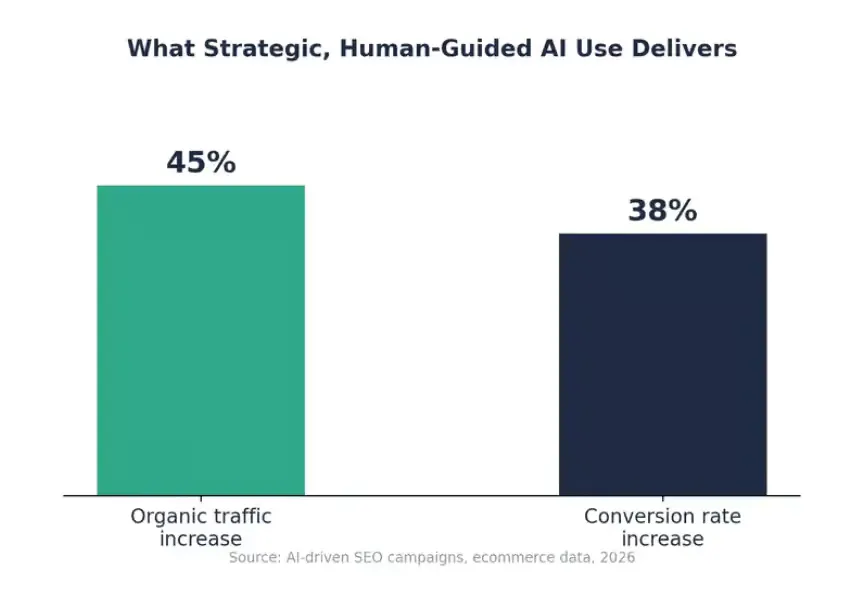
That lift comes from pairing the tool with the strategist behind it, not from swapping one for the other.
What a Time to Be an SEO Expert

Any AI platform can spit out a generic checklist. What it can’t do is know which items on that list actually matter for your business, your industry, and your market this year.
That takes an agency shaped by years of adaptation and real results, one that uses every available tool with a discerning eye over all of it. The people getting this right are the ones asking better questions of the AI, not just accepting its first answer.
That’s the whole game right now. Anyone can generate content. Fewer people can tell you which of it is actually worth publishing.
Sources
Aira, 2025 State of SEO Report.
https://sqmagazine.co.uk/ai-seo-statistics/
Demandsage, 65 AI SEO Statistics 2026. https://www.demandsage.com/ai-seo-statistics/
Ahrefs, 600,000-Page Ranking Study, 2026, via Phrasly. https://phrasly.ai/blog/does-google-penalize-ai-content/
SEOmator, 30+ AI SEO Statistics 2026 (Semrush data). https://seomator.com/blog/ai-seo-statistics
TrueRanker, Google February 2026 Update.
https://trueranker.com/blog/google-discover-core-update-february-2026-ai-slop/
Taylor Scher SEO, AI SEO Statistics 2026. https://www.taylorscherseo.com/blog/ai-seo-statistics
SEJ, 10 Top SEO Scams.
https://www.searchenginejournal.com/top-seo-scams/416351/


