Google confirmed its fourth spam update of the year on September 24, 2026, with 2026 being the “busiest” year for algorithm shifts so far.
If traffic dropped rapidly in September, here’s what happened, what didn’t necessarily happen, and a handful of insightful suggestions.
What Google Has Confirmed

On September 24, 2026, at 9:15 a.m. Pacific Time, Google’s Search Status Dashboard logged this line:
“Released the September 2026 spam update, which applies globally and to all languages.” A direct quote, with Google saying the rollout could take up to two weeks to complete.
NB: Google has not said which spam tactics the update targets.
The timing came with a Google announcement on multimodal search (searching with a mix of inputs, such as text, images, and voice) and an update to video structured data (code added to a page that tells Google details about a video, like its title, length, and upload date).
Some Algo trackers believe this update may focus on image and video search, but that’s a bit more of an educated guess and not quite a confirmed theory.
Core Updates vs. Spam Updates
A core update is a general “refresh” of how Google evaluates quality across the entire web. Core updates can recalibrate various factors and even the playing field. They take roughly two weeks to roll out, and because they aren’t aimed at one “tactic,” fixes need to be holistic.
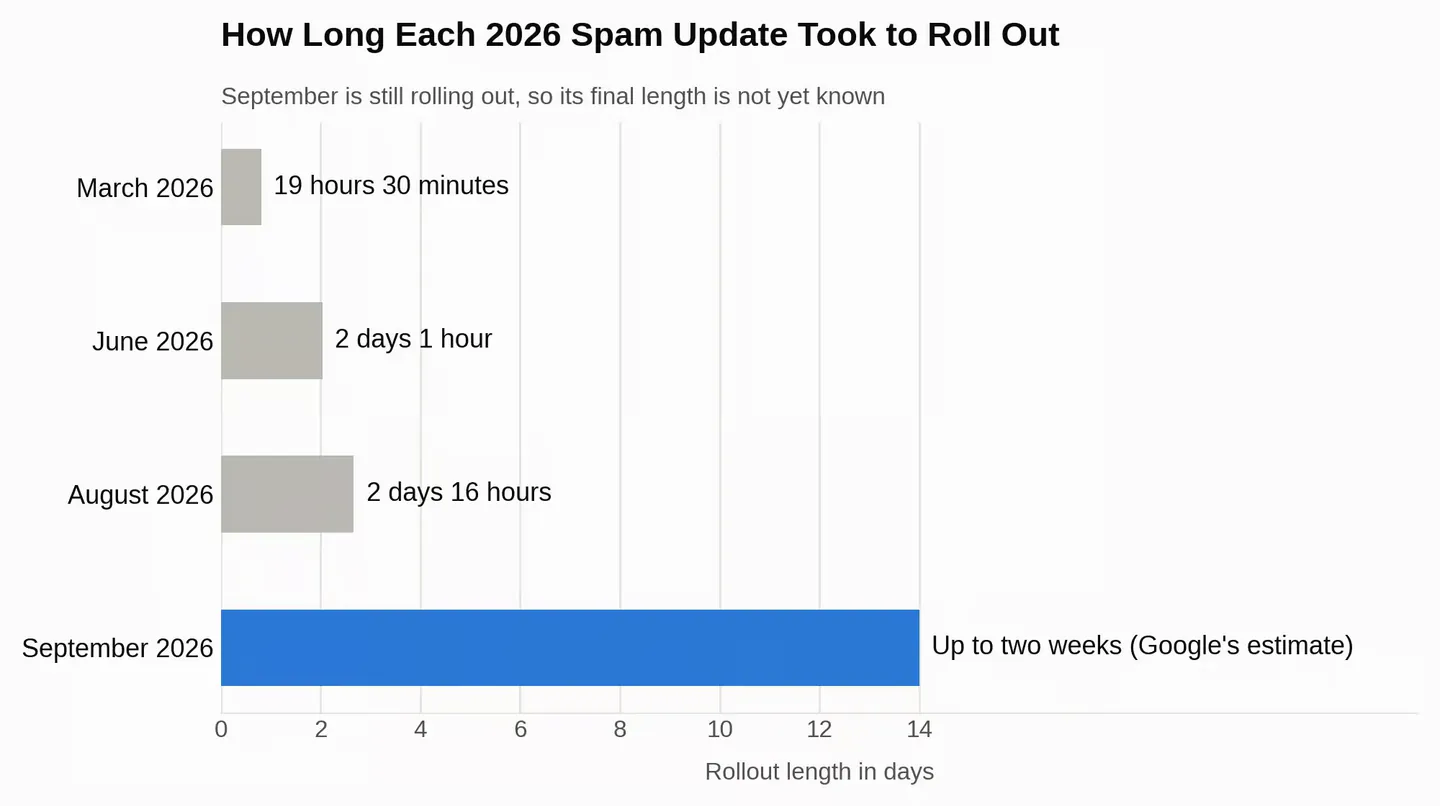
A spam update is much more focused. It improves how Google’s automated systems flag content and strategies that break its spam policies, so it can impact pages that go against guidelines. Spam updates usually wrap up quickly, which is why the March, June, and August ones finished in hours or days, though September’s ran for just shy of two weeks.
After a core update, you should concentrate on overall content quality. After a spam update, check your website against Google’s spam policies.
Why This Is the Most Active Year on Record
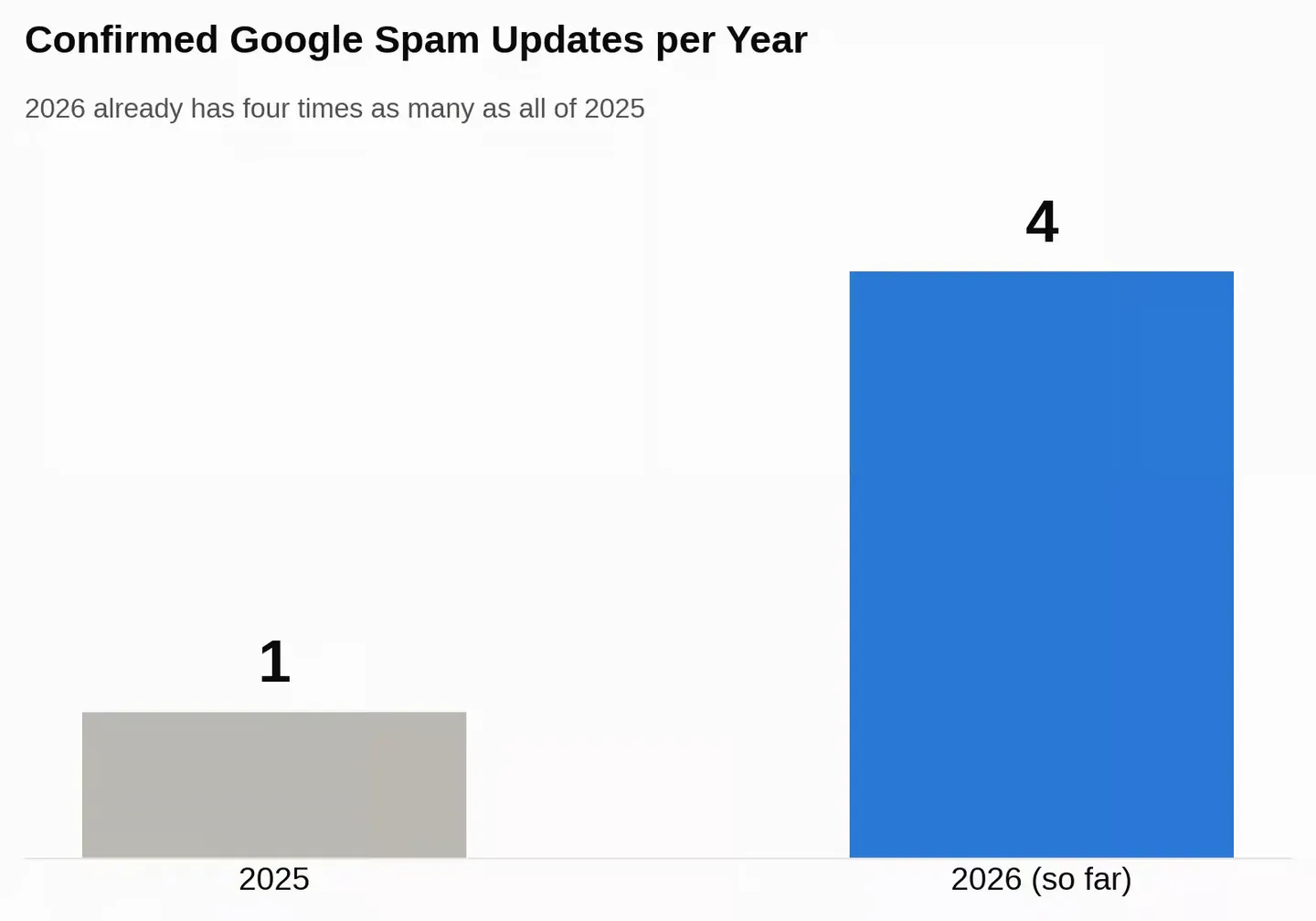
This is the fourth confirmed spam update of 2026! For comparison, 2025 saw only one spam update all year.
Here is how 2026 has gone so far:
- March 2026 spam update: 19 hours 30 minutes
- June 2026 spam update: 2 days 1 hour
- August 2026 spam update: 2 days 16 hours
- September 2026 spam update: 13 days 16 hours
That is on top of two confirmed broad core updates this year:
- From March 27 to April 8, the most volatile core update on record at that time saw top 3 rankings change by about 79.5%.
- May 21 to June 2 (heavier still, according to well-known independent tracker Glenn Gabe).
What About the “Unconfirmed” Early September Update?
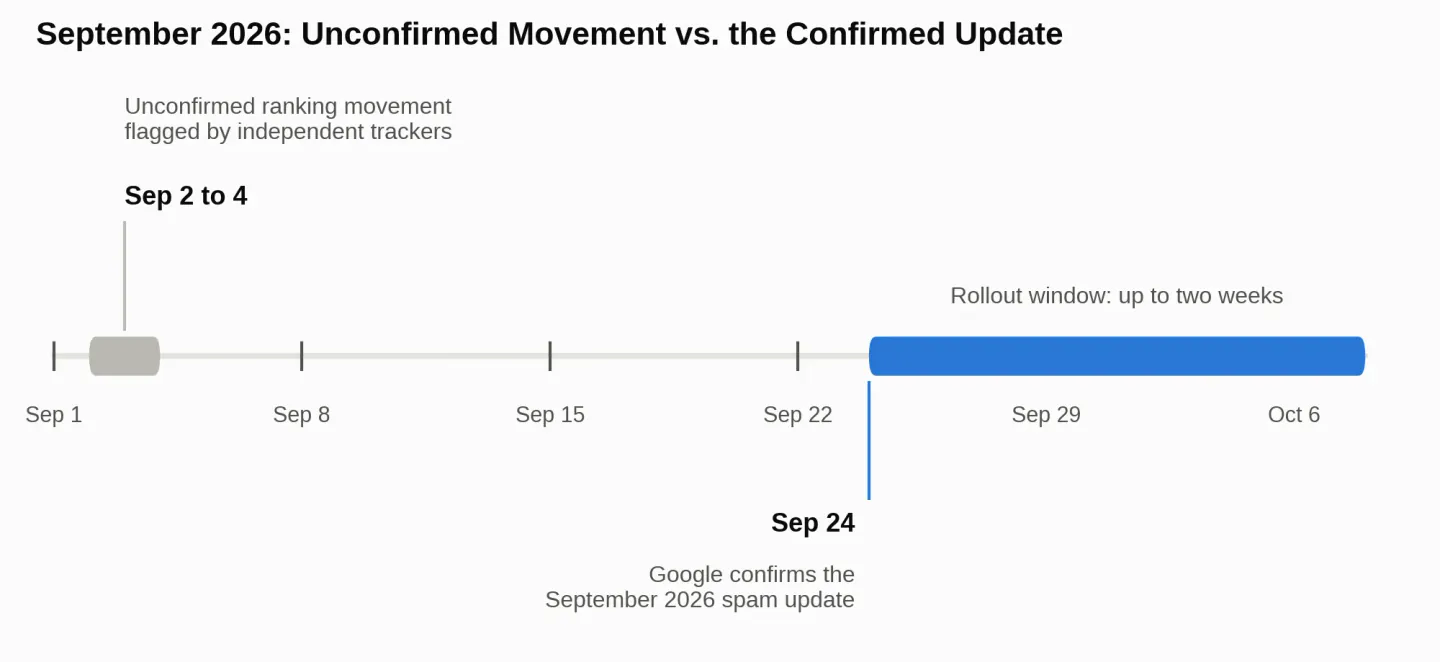
Two of the most trusted independent trackers in SEO, Glenn Gabe and Marie Haynes, both flagged real ranking movement around September 2 to 4, three weeks prior to Google’s confirmed spam update going live on September 24.
Neither of the tracker’s early readings became a recognized Google update, and Google’s dashboard has no records logged for that period.
This indicates a chunk of the ranking volatility site owners felt in the first week of September probably was not caused by a new algorithm after all.
It could have been the back end of the August spam update settling, or seasonal traffic shifts. The lesson is, simply put, to check your own Search Console data by day of the week, not only by date range, before assuming an “update” caused a trough.
No Broad Core Update Since May

It’s been a couple of months since Google’s last confirmed broad core update, which wrapped up on June 2, 2026.
Given the roughly three- to four-month gap Google kept for most of the year, many analysts expected a broad core update in Q3, around August or September. This may come to fruition at any moment.
Whether Google is saving one for Q4 or holding off longer this cycle, nobody outside of Google knows yet!
What Can You Do About It?

If your traffic moved in late September, compare Search Console data by day of the week, not date range, against the same week last year and against late August.
Read through Google’s spam policies, especially the rules on AI-written content and scaled content abuse (publishing lots of low-value pages just to rank). Three of the four spam updates this year leaned in that direction.
Keep building for the next core update instead of reactively trying to remedy issues.
Original data, edited copy, and authentic author credentials (the E-E-A-T basics) have been the bottom line of every 2026 update so far. Reach out to Poirier Agency and let us walk you through how one of our expert SEOs can support your business objectives.
Sources
- Search Engine Journal, “Google Rolls Out September 2026 Spam Update Globally”: https://www.searchenginejournal.com/google-september-2026-spam-update/590828/
- Search Engine Land, “Google Releases September 2026 Spam Update”: https://searchengineland.com/google-releases-september-2026-spam-update-491267
- Momentic Marketing, “September 2026 Spam Update”: https://momenticmarketing.com/google-updates/september-2026-spam-update
- Coalition Technologies, “The May 2026 Google Core Algorithm Update”: https://coalitiontechnologies.com/blog/may-2026-google-core-algorithm-update
- Dataslayer, “Google Core Updates 2026: Timeline, Changes and Recovery Playbook”: https://www.dataslayer.ai/blog/google-core-update-december-2025-what-changed-and-how-to-fix-your-rankings
- Single Grain, “Google Pushed an Update Nobody Announced”: https://www.singlegrain.com/seo/unconfirmed-google-update-september-2026/
- Search Engine Land, “Google September 2026 spam update done rolling out”: https://searchengineland.com/google-september-2026-spam-update-done-rolling-out-493550